
Recruitment in 2026: Embracing AI While Preserving Human Judgment.
2 April 2026
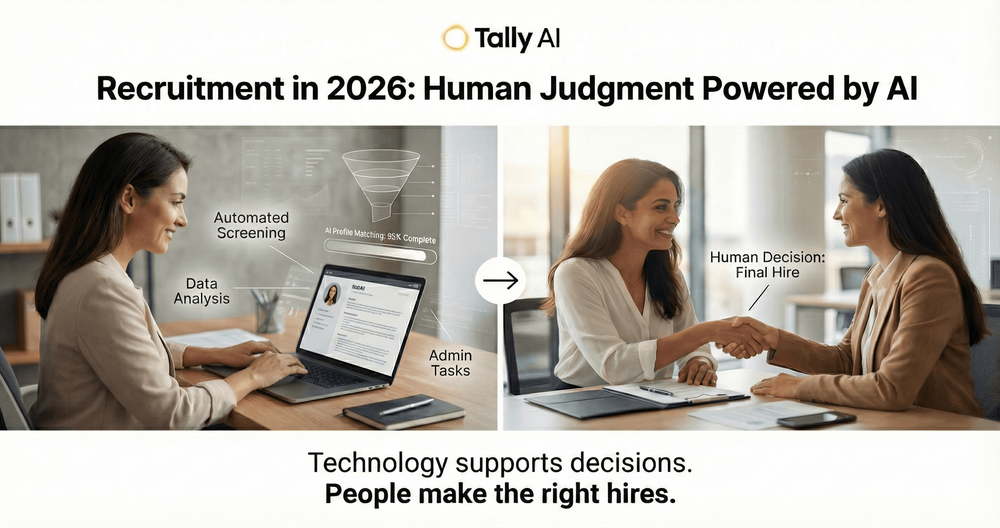
Recruitment in 2026 is defined by a more balanced, responsible use of Artificial Intelligence, with organisations adopting AI tools to support recruiters rather than replace human judgment. Rather than viewing AI as a substitute for recruiters, forward-thinking companies now see it as a powerful decision-support system that improves efficiency while maintaining accountability and legal compliance. Hiring remains a human-centred process, and organisations increasingly recognise that technology is most valuable when it strengthens professional expertise rather than attempting to replace it. This shift reflects a growing understanding that the quality of hiring decisions depends not only on data and automation but also on interpretation, context, and experience. Modern recruiters are embracing AI tools that enhance the recruitment process while ensuring that final decisions remain under human control. Early attempts to automate hiring completely revealed significant risks, including potential bias, lack of transparency, and regulatory concerns. As a result, companies now prioritise AI systems that support ethical hiring practices through structured evaluations, transparent processes, and documented decision-making. Human oversight has become an essential part of AI-assisted recruitment, ensuring that hiring decisions remain fair, explainable, and aligned with employment regulations. This approach allows organisations to benefit from technological efficiency while maintaining trust and compliance.
Human judgment continues to play a critical role because many important hiring factors cannot be fully captured by algorithms. Recruiters evaluate qualities such as growth potential, adaptability, communication style, and cultural alignment, which often require contextual understanding and professional experience. AI can identify patterns and highlight relevant candidates, but it cannot fully interpret individual ambition or organisational dynamics. Recruiters, therefore, use AI-generated insights as guidance rather than conclusions, combining analytical information with professional evaluation to make more informed decisions. Advanced recruitment platforms such as Tally AI are contributing to this evolution by improving the overall quality of hiring. These systems help recruiters identify strong candidates more efficiently by analysing skills, experience, and career trajectories in a structured way. Instead of relying solely on keyword searches, modern tools provide deeper insights into candidate suitability, allowing recruiters to focus their attention on individuals with genuine potential. By introducing consistency into the evaluation process, AI also helps reduce subjective variation, enabling recruiters to make comparisons based on clearer information while still applying professional judgment.
The use of AI also allows recruiters to dedicate more time to meaningful interactions with candidates and hiring managers. As administrative tasks become increasingly automated, recruiters can focus on understanding organisational needs, building relationships, and positioning opportunities effectively. This shift from transactional work to strategic involvement is improving both candidate experience and hiring outcomes. AI also expands the visibility of available talent, helping organisations discover qualified candidates who might previously have been overlooked, thereby strengthening talent pipelines and supporting more inclusive hiring practices.
Legal compliance has become a central consideration in AI-assisted recruitment, and organisations now require systems that support responsible use of data and transparent decision-making. AI tools must provide clear records of how candidates are evaluated and how decisions are made, ensuring that companies can demonstrate fair hiring practices when required. This emphasis on accountability reflects a broader recognition that organisations remain responsible for hiring outcomes, regardless of the technology used. By integrating compliance into AI-supported workflows, companies can reduce risk while improving the reliability of their recruitment processes. As AI becomes more integrated into recruitment, the role of recruiters is evolving rather than diminishing. Recruiters are increasingly acting as strategic advisors who interpret insights, guide hiring managers, and ensure that hiring decisions align with organisational goals. The most effective recruiters are those who understand both technology and human behaviour, using AI tools to strengthen their ability to make sound decisions. This combination of analytical capability and interpersonal skill is becoming a defining characteristic of successful recruitment professionals.
The future of recruitment will be shaped by organisations that successfully combine technological intelligence with human expertise. AI offers speed, scale, and analytical depth, while recruiters provide judgment, context, and trust. Together, these strengths create a hiring process that is more efficient and more reliable than either approach alone. The continued development of AI-supported recruitment demonstrates that technology does not diminish the importance of recruiters but instead enhances their ability to deliver high-quality hiring outcomes. In this evolving landscape, organisations that embrace AI responsibly while maintaining strong human oversight will be best positioned to build resilient and high-performing teams.