
Human Oversight in AI Is Making Headlines, But Tally AI Was Built This Way From Day One.
8 April 2026
Recent global debates about artificial intelligence have brought a critical issue into focus: the role of human oversight. Governments and technology companies are now openly debating whether AI systems should be allowed to operate in areas such as surveillance and automated decision-making without humans in control. Some AI providers have even faced pressure to remove safeguards that prevent their systems from being used for mass surveillance or autonomous weapons, highlighting how serious and urgent this conversation has become.
These discussions are important because they reveal a deeper question about the future of AI: Should artificial intelligence operate independently, or should humans remain responsible for decisions? At Tally AI, this was never a theoretical question or a reaction to recent events. It was one of the foundational principles behind how we built Tally AI. Long before human oversight in AI became a public conversation, we made a deliberate decision: Tally AI would always keep humans in control. Recruitment is a domain where decisions have real consequences for real people. A hiring decision can change the direction of someone’s career and livelihood. Allowing such decisions to be made automatically, without transparency or accountability, is not just risky; it is irresponsible.
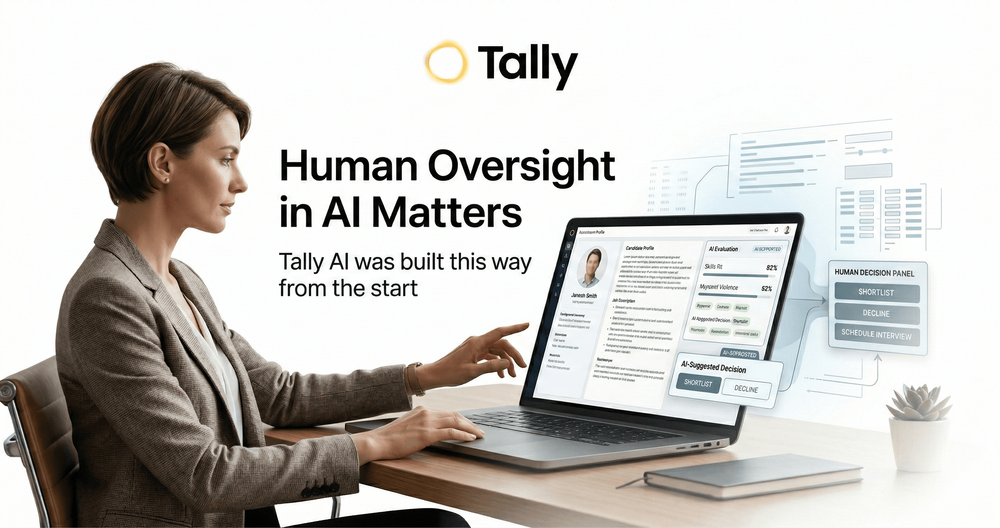
When we began designing Tally AI, we went deep into understanding what responsible artificial intelligence should look like in practice. We studied compliance requirements, ethical AI principles, explainable decision-making, and structured hiring methodologies. What emerged from that process was a clear conclusion: powerful AI systems must be designed so that humans remain responsible for outcomes. That belief shaped Tally AI at its core. Tally AI was never designed to operate silently in the background, making decisions on behalf of recruiters. Instead, it was built to assist professionals in making better decisions. The system analyses job descriptions and candidate CVs, produces structured recommendations, and provides clear explanations, but the recruiter remains the decision-maker. Every action is visible, every recommendation can be reviewed, and every decision is traceable.
Today, many organisations are only beginning to talk about ideas such as explainable AI, human-in-the-loop systems, and accountable decision-making. These principles are increasingly recognised as essential for trustworthy AI. But for Tally AI, they were not trends we adopted later. They were requirements we defined at the very beginning.The current global debate about AI surveillance and automated decision-making shows why this matters. When AI systems operate without sufficient human oversight, accountability becomes unclear. When decisions cannot be explained, trust disappears. And when data is not handled responsibly, organisations and individuals are exposed to serious risks. These risks are not limited to governments or military systems. They exist anywhere AI is used to make decisions about people, including hiring.
That is why Tally AI was designed with compliance, transparency, and human oversight built into the workflow itself. Every candidate evaluation is explainable. Every action is recorded. Every decision can be traced. The goal is not simply to make recruitment faster, but to make it more responsible. Artificial intelligence should strengthen human decision-making, not replace it. It should give professionals better tools, not remove their judgment. It should create clarity, not uncertainty. What the world is debating today reinforces something we believed from the start: the most powerful AI systems are not the ones that remove humans from the process; they are the ones that keep humans firmly at the centre.
Tally AI was built on that principle before it became a headline. And as the conversation around artificial intelligence continues to evolve, we remain committed to it.